
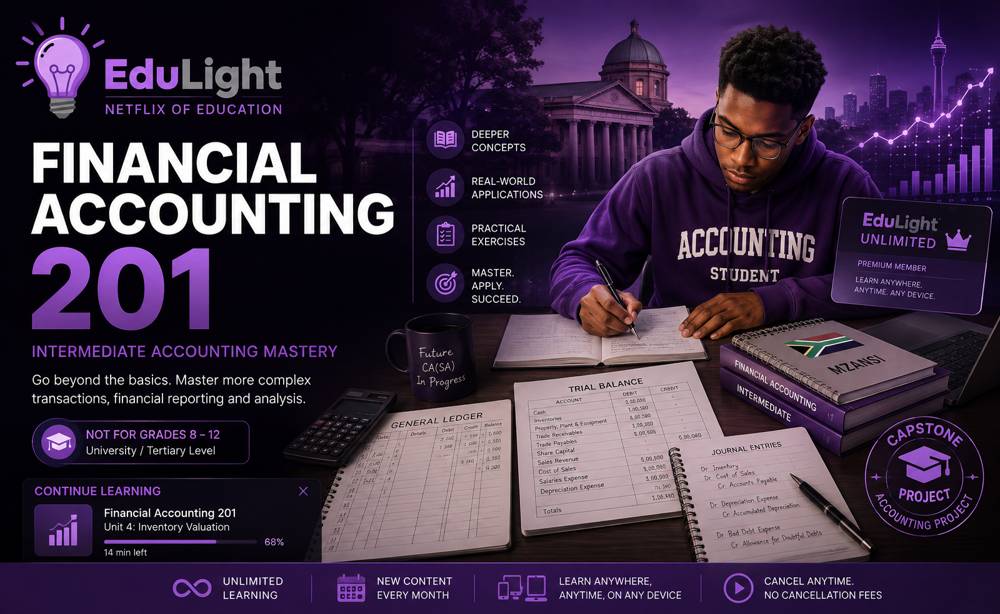
Financial Accounting 201

By EduLight Team Categories: Learning
Wishlist Share

About Course

Financial Accounting 201 builds on the practical accounting cycle you mastered in Financial Accounting 102 and takes you into intermediate financial reporting.

You will work through cash and internal controls, credit losses, advanced inventory and PPE treatments, provisions, borrowings, equity movements, cash flow information and financial statement analysis — then bring it all together in an integrated capstone.

This is a genuine step up: more judgement, more complexity, and the skills employers expect from a confident intermediate accounting student.

Membership Required

You must be a member to access this content.

View Membership Levels

Already a member? Log in here

What Will You Learn?

  • Classify cash and cash equivalents correctly and present them in the financial statements
  • Manage cash in a business using budgeting, the cash operating cycle and surplus cash techniques
  • Design and evaluate internal controls over cash receipts and cash payments
  • Operate a petty cash system using the imprest method
  • Account for cash shortages and overages and understand what they reveal about controls
  • Apply credit terms, account for irrecoverable debts and calculate expected credit losses
  • Present and analyse trade receivables using the allowance for expected credit losses
  • Apply advanced inventory valuation, cost formulas, write-downs and error corrections
  • Account for changes in depreciation estimates, component accounting and impairment of assets
  • Apply the revaluation model and account for disposals and replacements of non-current assets
  • Recognise, measure and disclose provisions, contingent liabilities, contingent assets and commitments
  • Account for short-term and long-term borrowings, interest, finance costs and accrued interest
  • Split borrowings between current and non-current portions and present them correctly
  • Account for capital contributions, drawings, distributions and retained earnings
  • Prepare and interpret a statement of changes in equity
  • Distinguish profit from cash flow and explain why cash flow matters
  • Classify and prepare operating, investing and financing cash flow information
  • Perform horizontal and vertical analysis of financial statements
  • Calculate and interpret profitability, liquidity and solvency ratios
  • Identify trends and problems in financial performance
  • Work through an integrated intermediate accounting problem from opening balances to final outputs
  • Avoid the common errors that undermine intermediate accounting work

Course Content

Cash, Cash Equivalents & Internal Controls

  • Cash and Cash Equivalents
  • Managing Cash in a Business
  • Internal Controls Over Cash
  • Petty Cash Systems
  • Cash Shortages and Overages
  • Improving Cash Control
  • Cash & Internal Controls
  • Practice Library: Cash & Petty Cash Exercises

Trade Receivables & Credit Management

Inventory: Advanced Applications

Non-Current Assets & Depreciation

Provisions, Contingencies & Commitments

Borrowings & Financing

Equity & Changes in Capital

Cash Flow Information

Analysing Financial Statements

Integrated Financial Accounting 201 Challenge

Financial Accounting 201 Mastery Test

Earn a certificate

Add this certificate to your resume to demonstrate your skills & increase your chances of getting noticed.

selected template

Student Ratings & Reviews

No Review Yet
No Review Yet

Want to receive push notifications for all major on-site activities?

✕