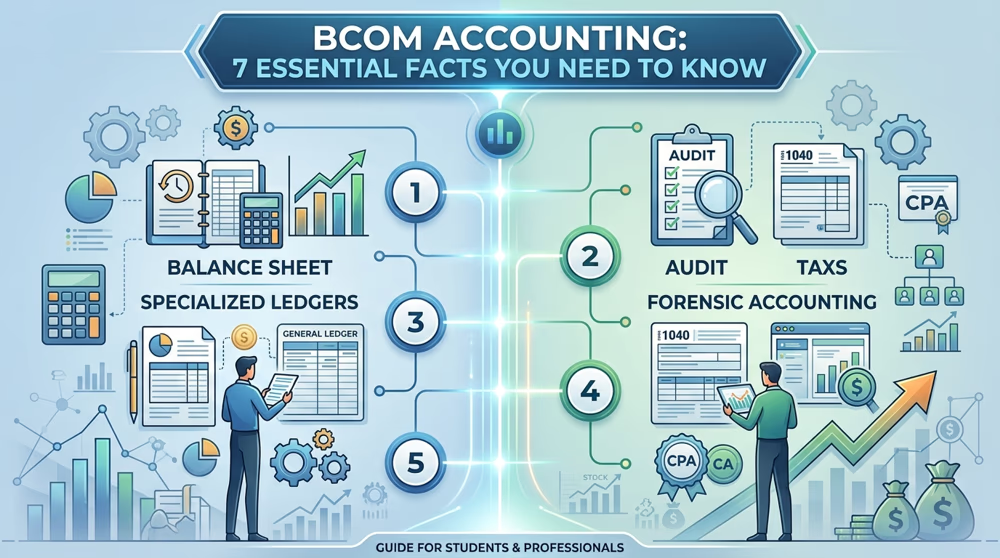
BCom Accounting: 7 Essential Facts You Need to Know
BCom Accounting: 7 Essential Facts You Need to Know
If you’re weighing up whether to study BCommerce Accounting, you’ve probably already come across a lot of scattered information — APS scores, module names, professional body acronyms, and conflicting advice about whether it’s the same as a BCompt. This guide pulls it all together in one place.
Here’s what BCom Accounting actually involves, what you’ll study, where it can lead, and what to expect once you’re in.
What Is a BCom Accounting Degree?
A BCommerce Accounting degree is an NQF Level 7 undergraduate qualification, typically completed over three years of full-time study. It sits under the broader Bachelor of Commerce umbrella, which means it covers accounting in depth while still including some general business subjects — unlike a more specialised Bachelor of Accounting Science (BCompt), which concentrates almost entirely on accounting, auditing, and taxation from year one.
This broader base makes Accounting a flexible starting point: useful whether you’re set on becoming a Chartered Accountant, or still deciding between accounting, auditing, and other finance-related careers.
What You'll Actually Study
Core modules across most BCom Accounting programmes typically include Financial Accounting, Auditing, Taxation, Management Accounting, Financial Management, and Corporate Law, with an emphasis on applying these skills practically rather than just memorising theory. First year usually starts broad, with an introduction to financial accounting alongside economics and business fundamentals, before the accounting modules become more specialised in second and third year.
Entry Requirements for Accounting
Entry requirements vary by university, but most Accounting programmes ask for an Admission Point Score (APS) somewhere in the 25–33 range, along with minimum marks for English and Mathematics — Mathematical Literacy is generally not accepted. Because requirements differ so much between institutions, it’s worth checking the specific APS and subject minimums for each university you’re applying to rather than relying on a single number.
Where a BCommerce Accounting Degree Can Lead
BCommerce Accounting is best known as a route toward becoming a Chartered Accountant — CA(SA) — through the South African Institute of Chartered Accountants (SAICA). That path usually means progressing to a BCom Honours in Accounting, then a postgraduate diploma or CTA, followed by three years of articles and board exams.
But SAICA isn’t the only route. Depending on the modules you choose, a BCom Accounting degree can also open the door to registering with the South African Institute of Professional Accountants (SAIPA), the Chartered Institute of Management Accountants (CIMA), the Association of Chartered Certified Accountants (ACCA), or working toward a Chartered Financial Analyst (CFA) designation.
7 Essential BCom Accounting Facts at a Glance
- It’s an NQF Level 7 qualification, usually completed in 3 years of full-time study.
- It’s broader than a BCompt. BCom Accounting includes economics, management, and business law alongside accounting, rather than focusing on accounting alone.
- Entry requirements vary by university, but most ask for an APS in the 25–33 range, with minimum marks for English and Maths.
- Core modules typically include Financial Accounting, Auditing, Taxation, Management Accounting, Financial Management, and Corporate Law.
- It’s a recognised CA(SA) pathway via SAICA, usually through Honours, CTA, and articles.
- It opens more doors than just CA(SA) — including SAIPA, CIMA, ACCA, and CFA routes.
- First-year modules set the foundation for everything that follows, so early struggles can compound quickly without the right support.
Starting Strong in Your First Year
Most students find that BCom Accounting feels noticeably faster-paced than school accounting — less repetition, more independent work, and concepts that build directly on top of each other. If a concept doesn’t click the first time, it’s worth addressing it early rather than hoping it resolves itself before the next test. Our accounting worksheets for university students are a good way to start practising the fundamentals from week one.
Get the Right Support From Day One of BCommerce Accounting
Whether you’re just starting out or already feeling behind, one-on-one tutoring can help you catch up on the exact concepts you’re stuck on, without wasting time on what you’ve already mastered.
Beyond Tutoring: Connect With Other Commerce Students
Studying Accounting doesn’t have to be a solo grind. We regularly run student events where commerce students can connect, share notes, and keep each other motivated through the semester.
Frequently Asked Questions
A BCom Accounting degree is an NQF Level 7 undergraduate qualification that combines in-depth accounting study with broader business subjects like economics, management, and business law.
Most BCom Accounting degrees take 3 years to complete full-time, though extended programmes with a foundation year can take 4 years.
Most universities require a pass in Mathematics (not Mathematical Literacy) and a minimum mark in English, alongside meeting the overall APS requirement, which varies by institution.
Yes. BCom Accounting is a recognised starting point for the CA(SA) pathway via SAICA, typically followed by Honours, a CTA, and three years of articles.
No. A BCompt is more specialised and accounting-focused from year one, while BCom Accounting includes a broader mix of business subjects alongside accounting.
This is common and doesn’t mean you picked the wrong degree. One-on-one tutoring can help you work through the specific concepts you’re stuck on before they compound into bigger gaps.
Yes. You can book a tutoring appointment through our booking page, or message us on WhatsApp first if you have questions before booking.
References
- University of Johannesburg — BCom in Accounting
- Wits University — Accounting
- University of Johannesburg — Accounting Organisations and Designations
Share This Article
Know someone deciding whether to study BCom Accounting? Share this article with them.