Understanding the Worksheet in Accounting: 5 Steps Explained
Worksheet in Accounting: 5 Confusing Steps Finally Explained
If your lecturer has mentioned the worksheet in accounting and you’re not entirely sure what it’s for, you’re not alone. It’s one of those tools that gets introduced quickly in first year and then assumed knowledge from that point on — which makes it worth actually understanding properly rather than half-memorising the column headings.
Here’s what the worksheet is, why accountants use it, and the 5 steps that take you from a trial balance to a full set of financial statements.
What Is the Worksheet in Accounting?
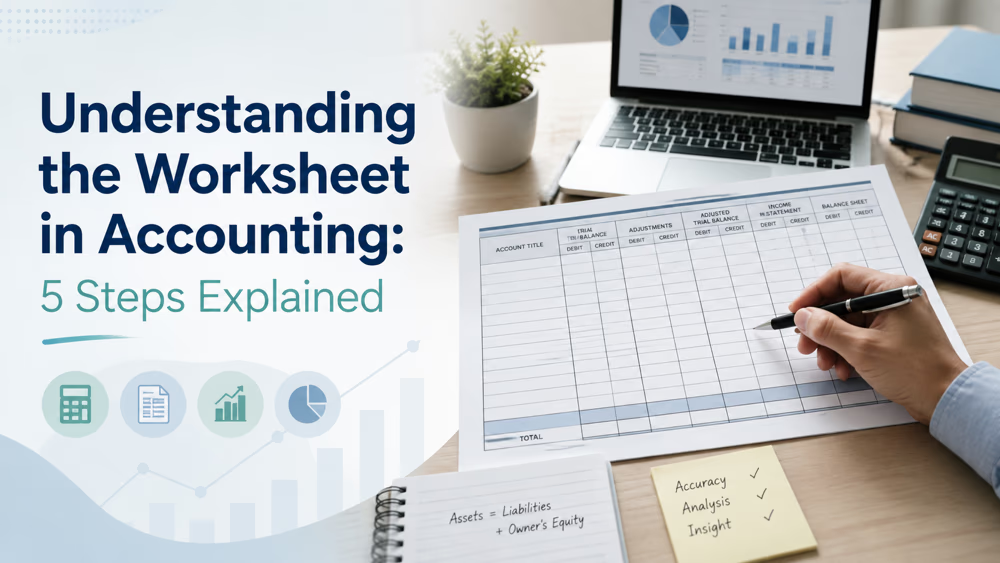
The worksheet in accounting is a working document — not part of the official financial records — that accountants use to organise figures before preparing formal financial statements. It’s typically laid out as a 10-column grid, with five pairs of debit and credit columns, and it exists purely to help you (or your lecturer marking your script) check that everything balances before you commit to a final income statement and balance sheet.
Because it’s a working tool rather than a formal report, mistakes here are easy to catch and fix — which is exactly why it’s taught early and used so often in first-year assessments.
The 5 Steps of the 10-Column Worksheet
- Trial Balance columns. List every account balance from the ledger, with debits and credits in their own columns. This is your starting point and should already balance before you go further.
- Adjustments columns. Record any adjusting entries — accrued expenses, prepaid amounts, depreciation, and similar year-end corrections — that haven’t yet been posted to the ledger.
- Adjusted Trial Balance columns. Combine the original trial balance with the adjustments to get an updated, accurate balance for every account.
- Income Statement columns. Move all revenue and expense accounts across from the adjusted trial balance to calculate profit or loss for the period.
- Balance Sheet columns. Move all asset, liability, and equity accounts across to reflect the business’s financial position at that point in time, incorporating the profit or loss figure carried over from the income statement.
Why the Worksheet in Accounting Actually Matters
The worksheet forces you to work through the accounting cycle in order, which is exactly why markers use it to see your thinking — not just your final answer. If your balance sheet doesn’t balance, the worksheet makes it far easier to trace the mistake back to the exact column, and often the exact adjustment, where it went wrong, rather than starting from scratch.
Practising the Worksheet in Accounting
Like most first-year accounting skills, the worksheet becomes far more intuitive with repetition than with reading alone. Our accounting worksheets for university students give you real practice questions to work through the full 5-step process yourself, rather than just watching someone else do it.
Still Not Clicking? Get One-on-One Help
If the worksheet still isn’t making sense after practising on your own, that’s usually a sign a concept earlier in the process — often adjustments — needs to be explained differently. A tutoring session lets you work through your actual attempt, column by column, until it clicks.
Beyond Practice: Connect With Other Commerce Students
Working through worksheets doesn’t have to be solitary. We regularly run student events where commerce students can connect, compare notes, and keep each other motivated through the semester.
Frequently Asked Questions
It’s a working document accountants use to organise trial balance figures, adjustments, and final account balances before preparing formal financial statements. It’s not part of the official financial records.
The standard version has 10 columns — five pairs of debit and credit columns covering the trial balance, adjustments, adjusted trial balance, income statement, and balance sheet.
No. The trial balance is just the starting point of the worksheet — the first pair of columns. The full worksheet extends that into adjustments and the final financial statements.
This usually comes down to a missed or incorrect adjustment, or a figure carried across to the wrong column. Working through it column by column, rather than searching for the error all at once, is the fastest way to find it.
Yes, most first-year courses expect you to complete a worksheet from a given trial balance and set of adjustments without a template, so practising the layout from memory is worth the effort.
Yes. Tutoring sessions can focus specifically on the areas you’re stuck on, including adjustments and worksheet preparation. We offer the best financial accounting tutor for university students. Book a FREE appointment today.
References
- Corporate Finance Institute — Accounting Worksheet
Share This Article
Know someone stuck on the worksheet in accounting? Share this article with them.